
2026 Spring Architectural History and Theory Talks will hold its second installment in 2026 Spring semester with Alexandra Staub, professor of architecture at Penn State University, College of Arts and Architecture, for a book talk titled “Architecture and Sustainability: Understanding the New Paradigm” on April 2nd, 2026, Thursday at 17:30. The talk series is organized by Aslıhan Günhan (Architecture) and Semra Horuz (IAED).
Zoom Link: https://zoom.us/j/4494464147?pwd=USCKjBmtXJCb8sPeKTQ5tG9oB3ODW6.1&omn=97214176976
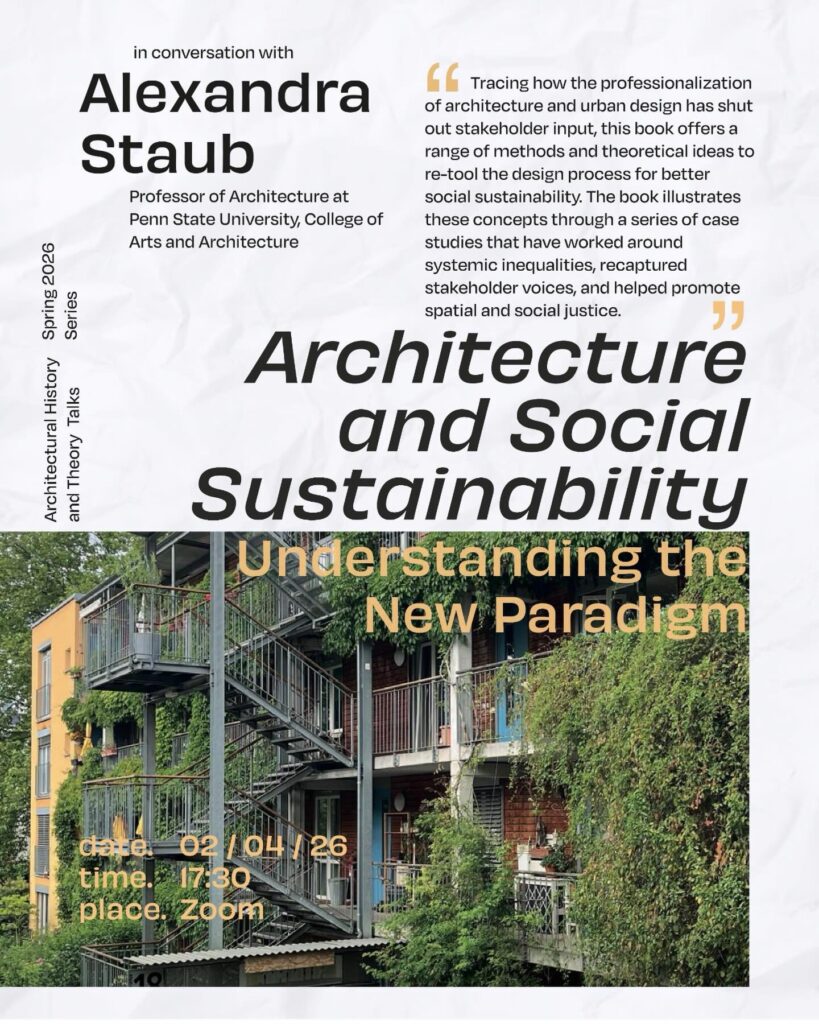
Architecture and Social Sustainability shows how we can better design for stakeholder agency, serve historically marginalized populations, and further our theoretical thinking about sustainability writ large.
With chapters exploring both the urban and the building scale, this volume examines the design of buildings and urban settings to illustrate how we can create more inclusive and equitable communities through broadening our design approach. Tracing how the professionalization of architecture and urban design has shut out stakeholder input, this book offers a range of methods and theoretical ideas to re-tool the design process for better social sustainability. The book illustrates these concepts through a series of case studies that have worked around systemic inequalities, recaptured stakeholder voices, and helped promote spatial and social justice. Case studies look at reparative urban and landscape design the United States, informal market structures in Nigeria, co-designed housing for low-income communities in India and Brazil, and participatory design for housing, schools, and healthcare facilities in Europe and the U.K.
Speaker Biography:
Alexandra Staub is a Professor of Architecture at Penn State University and an affiliate faculty member of the Rock Ethics Institute. Her work engages architectural history, theory, and ethics to examine how the built environment both shapes and reflects cultural, social, and political conditions. Her research focuses on design processes and their social implications, addressing questions of sustainability, power, and the role of class and gender in shaping spatial practices. As part of the Culture, Society and Space Research Cluster, she has led and supervised internationally oriented research on diverse urban and architectural contexts.